

Step one: Onboard your team. Step two: Train them in the basics (just enough to ensure compliance without investing too many resources). Step three: Take it easy from here on out and focus on production. Right?
Wrong. Relying on one-time food safety training to prepare your team for the ever-changing challenges of the food industry is a recipe for food safety incidents, when the goal is proactive risk prevention. Food safety is dynamic, but one-and-done training can leave your team struggling to adapt to new regulations, products, and risks as they emerge.
But why is relying on a traditional, time-bound training approach such a threat to food safety, and what can you do to protect yourself? Follow along as we break down this common operational misstep and offer expert insight into how a continuous learning framework can help your team stay proactive.
The Dangers of One-Off Training Plans and How Continuous Training Can Help
Food safety standards are driven by the latest discoveries, technologies, and industry insight. New ideas that change the way we look at manufacturing processes, shipping practices, storage techniques, and more can develop seemingly overnight — rendering previously held knowledge and processes moot.
Manufacturers that train employees only as often as they’re required to (whether by regulatory bodies or to meet certification standards) risk falling behind when industry, consumer, and regulatory expectations change.
That’s where a continuous learning approach to food safety training can set your business up for success. A continuous training model provides employees with regular training opportunities using an ongoing approach that adapts to industry expectations, evolving roles, and organizational change. Short, regular, up-to-date, and specialized training modules allow businesses to align their teams’ food safety knowledge with the latest regulations, guidelines, and best practices so they can act proactively, independently, and appropriately.
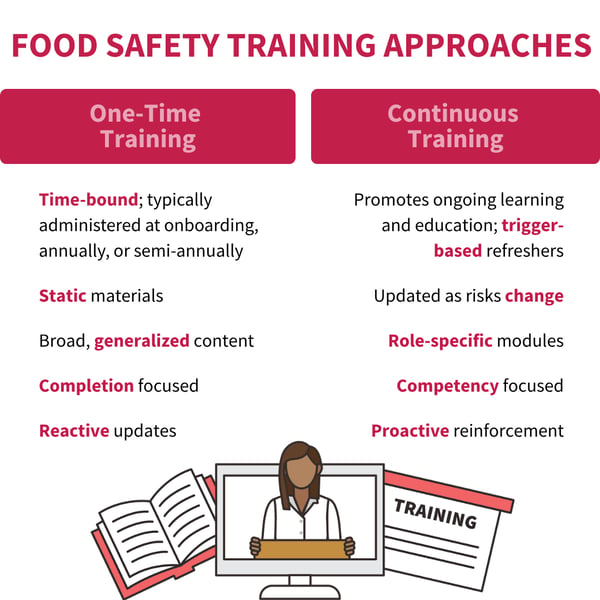
Let's take a look at a few key reasons a one-off training approach can fall short — and explore where adopting continuous learning principles can fill in the gaps:
Doesn't adapt to the latest regulations
The information your team learns during training may be the latest and greatest at the time, but regulations (and even your operations) can change — often. When your frontline team works from outdated information, it not only leaves your operation out of sync with the latest guidelines, but also exposes your products to potential risks.
Solution: Track regulatory updates from relevant bodies like the FDA and the European Commission, as well as new or changing guidance from international standards like Codex Alimentarius and GFSI-benchmarked certification schemes that your operations follow. Note trends in consumer expectations for transparency, labeling, and ingredient availability to anticipate potential operational changes. Then, establish a formal review process to determine whether existing training materials or standard operating procedures (SOPs) must be updated to reflect the latest standards. When a change affects frontline work, implement triggers for mandatory retraining for team members in relevant roles, verify their understanding, and document completion.
Information becomes void when procedures change
Internal operational adjustments, such as product reformulations, the introduction of new allergenic ingredients, updated SKUs, or new equipment, can also introduce new risks. And with new risks must come new risk prevention efforts. But it’s not enough to change procedures. Any implemented changes must be clearly communicated to frontline staff across roles and documented for future reference. It’s equally important to ensure that everyone involved in the procedure understands and can implement these updated expectations. Without re-training, your team could skip important sanitation steps or allergen management techniques, creating food safety vulnerabilities and potential consumer harm.
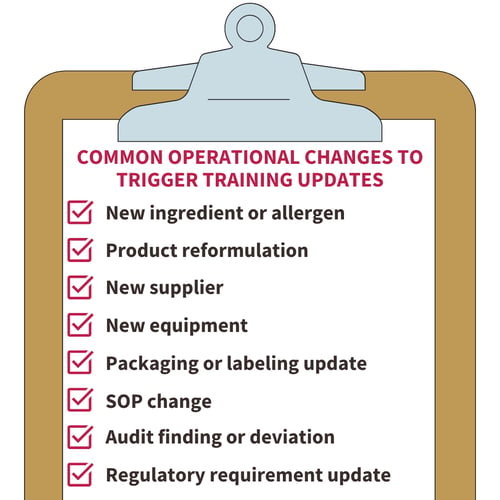
Solution: As with regulatory updates, internal operational changes must also be communicated to staff upon implementation. But a simple announcement isn’t enough. Team members must be trained on new processes that result from new allergens, products, suppliers, packaging, and more. It’s crucial that this training be administered before new procedures go live to ensure the changes are reinforced, practiced, and verified before employees must implement them independently. This reduces confusion among frontline employees and proactively addresses potential concerns rather than reacting after an incident occurs.
Employees forget training over time
Even with the best training available, employees will forget at least some of what they've learned without regular reinforcement — it's human nature. First observed by the psychologist Hermann Ebbinghaus, the “forgetting curve” shows that people can forget a significant amount of new information within a week of learning it without receiving supplemental training. In food safety, even a partial drop-off after training can lead to dangerous knowledge gaps in preventive actions such as sanitation and hygiene if left unchecked.
Solution: Assess your team’s training retention through on-the-floor observation, surveys, and informal interviews. From there, identify knowledge gaps and build a continuous training schedule to reinforce foundational concepts while introducing new, vital information in specialized or modernized topics. Offer refresher trainings through bite-sized, accessible e-learning modules that your team can complete quickly at their convenience to reduce downtime while strengthening retention.
Fails to build and maintain a food safety culture
Beyond relevance and retention, a single training session is not enough to change or reinforce your team’s overall view of food safety and its importance. How you structure food safety training within your operations — whether you administer it just often enough to meet requirements or integrate it into the fabric of everyday operations — can determine whether your team sees it as simply a box to check or a way of life that actively prevents dangerous food safety incidents.
Solution: Regularly reinforce the importance of food safety to your employees through continuous training that emphasizes behavioral change. This ongoing education doesn’t always have to be time-intensive; morning huddles, casual conversations, and simply reviewing deviations with the team to discuss what has happened and what they’ve learned are excellent ways to reinforce training and foster a continuous learning environment. This also applies to training for non-food-safety workers, who play an often understated role in your facilities’ food safety culture. Continuous training and reinforcement of food safety principles demonstrate your organization’s ongoing commitment to food safety to both employees and consumers.
Falls short on proactivity
In addition to training upon hire, many food safety training programs require periodic refresher training, retraining after procedural changes, or additional training following deviations, observed hazards, or audit findings to remain compliant.
But if proactive prevention of food safety incidents is your goal, simply meeting the bare minimum requirements or responding after a hazard is observed isn’t enough. If your team doesn’t remain informed of the latest updates, they will struggle to adapt when you implement new, necessary processes to remain compliant and protect your consumers in today's fast-paced food safety environment.
Solution: Adapt your training program to allow employees to retrain as changes occur and in anticipation of upcoming changes, rather than at the required frequency. Going beyond recommended and required standards will not only allow you to meet those standards, but also keep your team ahead of the game as regulations and internal processes change. Investing in this continuous learning upfront will lead to better food safety outcomes and efficiency down the line.
Relies on a single training method
Your team shouldn’t learn everything they need to know through just one type of training either. To start, not every employee has the same learning requirements — whether due to language barriers or learning styles. Additionally, different subjects lend themselves best to different training methods; some concepts work well in classroom or e-learning settings, while others benefit from on-the-floor training directly in the production environment.
Consider the 70/20/10 model of learning. Under this philosophy, 70% of learning occurs through hands-on education, 20% through social interaction, and 10% through a classroom setting. With sporadic or one-time training sessions, your team will likely struggle to retain a large portion of important information due to a lack of training diversity.
Solution: As you hone your training program, consider both the audience you’ll be training — their role in your operation as well as their communication and learning styles — and the concepts they must learn. Explore various training methods and how they work best in each scenario. For site-specific topics, for instance, consider bringing in an outside expert to provide private training on-site. For general regulatory training, lean on e-learning courses that offer the flexibility to scale and adapt to your team’s language preferences.
How to Effectively Implement a Continuous Training Plan
Looking to implement more continuous learning principles in your organization, but not sure how to get started? With a strategic approach, building an effective training plan is simple. Consider these tips as you transition to a continuous training model.
-
Pivot to a blended training model: Blended training mixes e-learning and in-person training methods to offer flexible options that better facilitate an ongoing training schedule. This training style also allows you to scale and adapt more effectively to diverse training needs, such as multilingual teams.
-
Identify skills gaps: Before you schedule specialized or refresher training courses, you must first know which areas need the most reinforcement. Continuously identifying and addressing these knowledge gaps will help maximize your investment in training and ensure your team receives a well-rounded food safety education.
-
Use micro-learning modules: A common training roadblock for businesses is downtime. But with a micro-learning approach to continuous education, you can keep your team fresh with manageable 15-minute training sessions that provide valuable learning without compromising efficiency or overloading them with information.
-
Verify understanding: Administering training on a regular basis isn’t enough; you must also ensure your team internalizes and applies that training during everyday operations. Use brief knowledge checks, supervisor observations, pre-op reviews, and hands-on demonstrations to confirm employees can apply updated procedures correctly on the floor.
-
Gather feedback and optimize: An essential part of an effective continuous training system is constant improvement. Collect employee feedback through informal interviews or feedback forms to identify and address opportunities to improve training methods or content.
Pinpointing your training needs and optimizing your training to match will allow you to better schedule and maintain a continuous training program. But if you're looking for experienced help adapting your training program for a more ongoing approach, partnering with food safety training experts can help you transition with confidence.
Changing How You Approach Training to Reduce Vulnerabilities
Don't leave yourself exposed to potential training-related food safety risks. Emphasize the importance of continuous learning within your team and witness firsthand changes in employee confidence, performance, and culture.
Want to pivot your training plan more efficiently? Explore AIB International’s library of food safety training course options to help educate your team on everything from the basics to specialized certifications. Or work alongside an experienced educator to evaluate your current training program and collaborate to build the best program for your team's needs.