

Investing in food safety training is an easy way to keep your team at the forefront of regulatory updates, improve food safety operations, and upskill your workers. Still, not all trainings are created equal. Investing in training that fills knowledge gaps can reap significant benefits; likewise, signing up for a subject your team is already well-versed in or which doesn’t apply to them could waste time and resources.
To ensure you're maximizing the benefits of your food safety training, you must conduct a training needs assessment. This assessment can identify the gaps in your employee’s knowledge or skills, so you can make an informed decision on the best training to prioritize for your team.
Let’s explore what the assessment process looks like and why it matters.
Why Strategic Food Safety Training Is Essential to Success
Sometimes your team lacks necessary food safety knowledge because of new product formulations or changing compliance standards; other times, they might just need a refresher on food safety best practices. Whether you’re trying to keep your team up to date on the latest regulations or just want them working at their maximum potential, investing in quality food safety training can make a significant impact on your operations.
That said, the best way to optimize your results is to think strategically about where your team needs the most help. Food safety training is an investment, after all; one that should yield a return in the form of operational improvements.
To start your search for the right food safety training courses, ask yourself:
-
Where are we seeing the most issues?
-
Are there any regulatory updates we need to catch up on?
-
What elements of our food safety plan are the most outdated?
-
How long has it been since we've had a training on [topic]?
-
Are there any certifications we should consider acquiring?
These questions will help you take a detailed look at the current state of your team's food safety knowledge. Providing your employees with targeted food safety training can help you capitalize on the time you're setting aside from normal operations.
It's also important to think strategically about who is in most need of training. Certain positions or departments may require more frequent or in-depth training. Others, like non-food-safety workers, may have less hands-on experience to draw from.
Not only is keeping a finger on the pulse of your team's food safety knowledge gaps important for maximizing the value of training, but it’s also a required element of training programs under food safety systems like SQF. That's why a standardized method of pinpointing these training needs is so valuable.
How to Perform a Training Needs Assessment
You know that your team could benefit from training, but you're not quite sure what that training should be about yet. So how can you go about assessing your employees’ knowledge gaps?
A systematic approach to evaluating your employee knowledge base will help you make more strategic decisions about what training will be most valuable. That’s where a training needs assessment comes in.
Follow the key steps below to get your internal evaluation started. During your assessment, document the process to ensure efficient repeatability, recordkeeping, and review.
1. Define your goals and scope
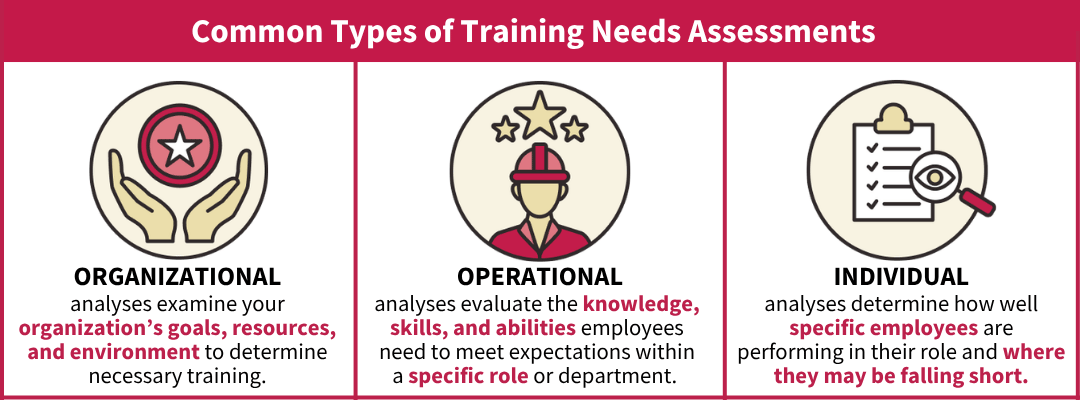
Training needs assessments can take many different forms, ranging in scope and often falling into one of three categories:
-
Organizational: Evaluates the training needs of your entire workforce, working to align knowledge with overarching strategic goals and requirements.
-
Operational: Evaluates the needs of a specific role or department. For example, this could include evaluating a PCQI’s skills to ensure their knowledge is up to date.
-
Individual: Evaluates the needs of a specific employee. These assessments may be used if management notices a dip in performance or a pattern of mistakes from a specific individual.
The scope of your training needs assessment will likely be driven by your "why." Defining the goals of your investment will clarify who must be evaluated, why, and what they need to learn. If, for example, your goal is to emphasize and encourage your organization’s commitment to food safety culture, a general refresher training on best practices may be a good fit.
2. Collect and analyze employee data
Once you have a clear goal and scope in place, you will need to collect qualitative data from your team regarding their current competency levels. You can do this using a variety of methods:
-
Assessments
-
Questionnaires
-
HR records
-
Incident reports
-
Focus groups
-
Interviews or informal conversations
The data you collect must then be analyzed to determine your team's current skill level. Be on the lookout for specific knowledge or skills gaps and why these gaps exist. From there, you can identify what topics are in most need of attention, who is in the most need of education, and run a cost-benefit analysis on investing in third-party food safety training.
3. Identify and evaluate training options
Your training goals and employee data should both inform which training opportunities best fit your needs. Cross-reference training curriculums with the knowledge gap data you collected. Refresher training is valuable, but modules that cover identified food safety knowledge gaps may offer more significant overall benefit for your team.
Consider vendors’ training methods as well. eLearning courses are useful for teams who work better at their own pace, but in-person training may better suit your employees' learning styles — particularly if you're looking to educate a large group all at once.
4. Repeat regularly
In the world of food safety, regulations and guidance are constantly changing. That's why your training needs assessment can’t be a one-time process. Regularly evaluating your team's food safety training needs lets you stay ahead of any potential gaps and identify opportunities to upskill employees proactively (rather than in response to an issue or incident).
As you repeat this process, you can also find opportunities to improve your assessment methodology based on previous results and your company's strategy. However, you may find that a little outside perspective can be valuable when it comes to fully understanding your training needs. Consider partnering with third-party experts who can handle this assessment for you year after year.
Optimizing Your Training Journey With Expert Help
Regularly assessing your team’s skills and knowledge is absolutely necessary to maintaining food safety, but even at a small scale, doing so can strain your resources beyond their capacity. Thankfully, your team doesn’t have to do it on their own. To get the insights you need without interrupting operations unnecessarily, assign an expert from AIB International to perform a training needs assessment on your behalf.
With the help of a third-party expert you can discover your team’s knowledge and skills gaps, get recommendations for potential training solutions, and learn how to better navigate food safety training in today's environment. Whether you hire an expert or do it yourself, these assessments are an essential part of keeping your business ahead of the curve.