

Training is foundational to your business’s food safety efforts, affecting everything from compliance to employee satisfaction. But cracks in your foundation can lead to unforeseen vulnerabilities, operational failures, and even employee turnover. These weaknesses open the door to food safety incidents that could leave you scrambling to recover.
Filling training gaps — from language barriers to low engagement to a lack of documentation — is essential to knowledge retention and compliance. But what deficiencies could be hiding in plain sight, and what can your team do to prevent them?
Follow along as we provide insight into the threats that food safety training gaps pose to your operations, common examples of these gaps in the food manufacturing industry, and how your team can proactively eliminate them.
The Threat of Food Safety Training Gaps
Whether due to lapses in training updates or simply failing to address skills gaps in your workforce, food safety training deficits present a cascading domino effect of potential threats to your compliance and reputation. To better understand how these gaps can impact your business, consider the following threats and their resulting consequences:
Misunderstanding SOPs
A lack of information translates to a lack of comprehension among your team. Whether your training lacks multilingual options to accommodate the diversity of your team or your training modalities don’t suit every team member’s preferred learning styles, employees who don't fully understand your standard operating procedures (SOPs) — and why they are in place — are sure to make mistakes that can lead to food safety incidents.
Risk of Turnover
Confusion can also lead to frustration among your employees. This frustration — combined with a lack of confidence, higher stress, and lower job satisfaction — can result in higher employee turnover. As employees churn through your organization, your training gaps can also widen due to a lack of institutional knowledge — creating an ever-growing threat of future incidents.
Outdated Procedures
If your training doesn’t align with the latest regulations, your operating procedures could fall short of current food safety standards. If, for instance, your traceability training doesn't include the latest FDA updates or SQF document controls, you could be at risk of noncompliance due to inadequate documentation practices.
Lack of Proactive Capabilities
Teams that aren't properly prepared are incapable of performing proactive prevention. Missing out on this essential food safety strategy can be detrimental to your business — because when you're reacting to a food safety failure, it's often too late to avoid the resulting public health, financial, legal, and regulatory consequences.
In particular, gaps in your training on prerequisite programs can deprive your employees of the basic food safety knowledge they need to confidently minimize vulnerabilities before they develop into costly and dangerous issues.
Operational Failures
A lack of proactive prevention, operational misunderstandings, and outdated procedures can culminate in operational failures like outbreaks, allergen cross-contact, or other critical incidents that place your facility and product supply at risk. Failures in areas like sanitation and allergen controls can also pose serious risks to your consumers, and your business will ultimately be held accountable.
Recalls and Violations
As failures occur, their consequences can damage your reputation, financial stability, operational efficiency, and pose a threat to public health. If an operational failure results in mislabeling a product's allergens, for example, it could lead to significant danger to consumers, as well as costly recalls, potential legal fees, operational shutdown costs, and possible sanctions from regulatory bodies.
Common Training Gaps in Food Safety Curriculum and How to Avoid Them
It’s clear that food safety training gaps are a threat, but the question remains: How do you spot them and minimize their potential impact? To help defend your operations from training-related perils, keep these common training gaps (and how to avoid them) in mind.
Not Covering the "Why"
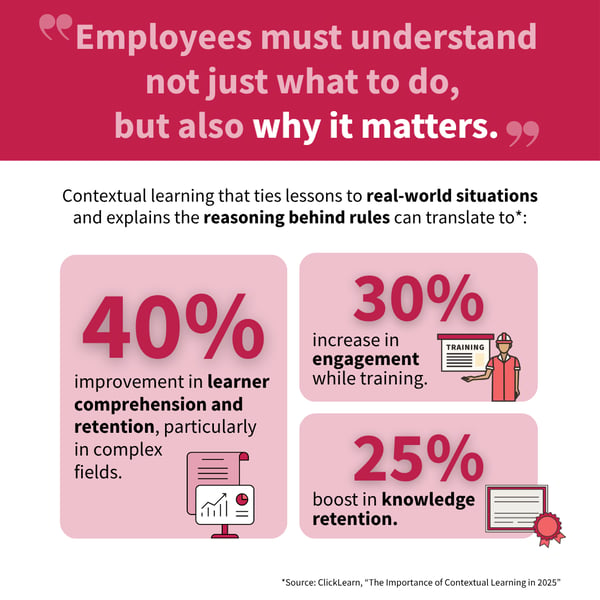
Employees must understand not just what to do, but also why it matters. Teaching your employees food safety procedures is the right first step, but they also need to understand the logic behind your SOPs. Training programs that neglect to provide context for why employees must perform certain actions may lead to lower retention and comprehension rates.
After all, contextual learning that ties lessons to real-world situations is shown to improve learner comprehension and retention by up to 40%. Similarly, organizations that add the "why" to their training can see 30% increase in engagement and a 25% boost in knowledge retention.
Understanding the "why" behind your food safety protocols is also essential for building a strong food safety culture, as it motivates employees to follow established procedures, report potential threats, and buy into company policies.
 Solution: After training, conduct evaluations with your employees through informal interviews or surveys to gauge their understanding of the reasoning behind established policies. If you notice knowledge gaps in certain areas, provide educational materials during training and around your facilities that offer further explanation, such as visual guides showing how poor hygiene and sanitation practices can lead to cross-contamination.
Deprioritizing Training Documentation
Documenting your team's training records is not only essential to achieving compliance, but it's also crucial for validating competence. Inspectors and auditors will want to review your training documentation to ensure that your employees meet the requirements of food safety schemes like the Food Safety Modernization Act (FSMA) and GFSI-recognized standards like SQF, and to verify that they are applying those concepts correctly on the job.
Solution: Establish a clear training documentation process by working with experts who understand regulatory requirements, common missteps, and how to implement systems successfully. Make sure you communicate the importance of accurate documentation to your team, too, as their buy-in will make all the difference in establishing and maintaining an effective recordkeeping process.
Lack of Ongoing Training
Because regulatory expectations are ever-shifting, team members come and go, and modern preventive food safety standards adapt over time, food safety training can’t be a one-time operation. Teams that don't regularly refresh their food safety knowledge are sure to fall behind on compliance. A one-and-done approach to food safety training also neglects opportunities for specialized education that can both provide value to your organization and drive personal fulfillment within your workforce — improving employee retention.
Solution: Invest in continuous training. Build a schedule that keeps your team consistently refreshed on general food safety concepts while providing opportunities for specialized training to qualified staff members, such as food defense coordinator or labeling classes.
Language Barriers
Your team is unlikely to all speak the same first language. Without adapting to your diverse workforce's comprehension needs, you risk generating misunderstandings and resulting food safety issues. Language-related misunderstandings are particularly common in manufacturing. Research from the Netherlands found that 46% of all misunderstandings in manufacturing stem from team members speaking different languages.
Solution: Implement multilingual training strategies like visual-based trainings, translated materials, e-learning options, and multilingual trainers. Online food safety training modules often offer multiple voiceover language options or real-time translation capabilities, while multilingual trainers and leadership can help foster a food safety culture that encourages comprehension and clear communication across backgrounds and native languages. This allows you to provide a consistent, accurate education across your entire workforce.


Poor Engagement and Retention
If your team isn't actively learning during training, there's a good chance they won’t retain crucial information beyond it. They may pass a post-training assessment, but how well will they be able to draw upon this knowledge in real-world situations?
Evidence shows that active learning strategies lead to better educational outcomes than traditional passive strategies across engagement, retention, and long-term recall. Gamification, for example, can help boost engagement during training significantly compared to traditional methods. What’s more, Gallup meta-analyses have consistently found a correlation between employee engagement and business outcomes like productivity and profitability. And when retention is the difference between preventing and causing a foodborne illness outbreak, you can't afford for your employees to lose focus or struggle to comprehend course materials.
Solution: Develop a training program that features and emphasizes active learning strategies. Once you complete and implement your program, collect feedback from trainees to find opportunities for improvement and make the necessary adjustments to improve future training.
Inadequate Training of Temporary Staff
Seasonal workers play a significant role in maintaining operational efficiency during busy times of the year. But these temporary workers can prove to be a hidden liability if they don’t receive quality food safety education — and whether due to time constraints or high demand, they’re often neglected when it comes to proper onboarding and training.
Temporary staff who are undertrained (in addition to lacking the foundation of institutional knowledge of your permanent staff) are particularly prone to mistakes. These mistakes can lead to food safety incidents and discourage temporary staff from returning when you need them again in the future.
Solution: To account for knowledge gaps among your temporary staff ahead of time, conduct skills assessments as part of their onboarding procedure. Provide training to address any identified deficiencies and offer easily accessible educational support materials for quick reference while they’re on the job.
Missing Specialized Training
Basic food safety training, like that found in prerequisite programs, is an essential piece of the food safety puzzle. But failing to invest in specialized education, such as food defense training or PCQI courses, can create knowledge gaps among your team in crucial prevention areas.
If you are investing in specialized training, make sure it is up to date with the latest policies. For example, PCQI 2.0 training includes key curriculum updates from the FDA that could make or break your compliance.
Solution: Find a food safety training partner with a diverse course library that offers training options best suited to your team's unique needs and specializations — including food safety scheme certifications.
Filling in Your Food Safety Training Gaps With Expert Help
Training gaps can easily turn into compliance gaps if left unchecked. That's why finding and fixing these vulnerabilities is essential to building a food safety training program that drives success. Not sure where to start? Consider leaning on food safety education experts for help.
AIB International offers a wide range of food safety training programs — from e-learning modules to in-person, site-specific training. Using these resources can help you easily fill educational deficits and develop a continuous training program. Expert consultants can also help you better identify training gaps by analyzing your current training regimen, pinpointing where you can improve most, and providing actionable strategies to shore up your program.