

Effective supply chain programs are an essential element of compliance with the FDA’s Food Safety Modernization Act, as well as Global Food Safety Initiative schemes like SQF, BRCGS, and FSSC 22000. But while these regulations prioritize risk-based program design, manufacturers sometimes fall short in executing their supplier programs, despite meeting requirements on paper.
Too often, supplier programs rely on documentation as a proxy for risk control, conducting audits without following up to confirm that controls are working consistently, or relying on intermittent monitoring that limits visibility into supplier operations and real-world performance. The result? Manufacturers are left performing post-incident damage control to mitigate costly, dangerous, and preventable food safety incidents.
Instead of waiting for these incidents to strike your supply chain and relying on quick response times to deal with the fallout, take a proactive stance toward risk prevention. Follow along as we highlight the dangers of reactivity, explore how to assess where your current supplier program stands, and share strategies to improve it long-term.
The Consequences of Reactive Supplier Programs
If you're reacting to food safety risks in your supply chain rather than mitigating them, you're already one step behind. Simply meeting supplier program compliance standards isn’t enough; a lack of risk-prevention strategies can lead to unidentified vulnerabilities along your supply chain, which snowball into food safety incidents that can have significant ramifications for your business.
Resulting supply chain disruptions can delay delivery timelines, lead to ingredient shortages, increase costs, and impact product quality, leaving your team scrambling to meet production deadlines. And that’s if the issue is identified before it reaches your facility. If altered or contaminated ingredients reach distribution, it could spell disaster in the form of consumer harm, product recalls, reputational damage, and regulatory consequences.
These issues can be detrimental to operations of any size, which is why staying ahead of the risks that cause them is so vital to your supply chain management.
Is Your Supplier Program Preventing Risks?
The difference between an effective and ineffective supplier program lies in its ability to prevent food safety incidents, intentional adulteration, and food fraud before they occur, rather than respond to them after the fact. But how do you know if your program is truly preventive? These key indicators can paint a picture of your supplier program's effectiveness.
Supplier Segmentation
Some suppliers are at a higher risk of food safety incidents than others. Those that supply products more vulnerable to economically motivated adulteration, for instance, may be considered at higher risk of food fraud.
In the same way, some suppliers have a greater impact on your overall profitability than others. These factors affect how much attention each supplier requires, and should determine how closely you manage them. Grouping suppliers based on risk, profitability, and other key factors is called supplier segmentation.
If your supplier program doesn't employ this management method, you could be wasting precious resources on lower-risk suppliers, while other high-risk suppliers go without the attention they need. This lack of prioritization can lead to unnoticed food safety gaps like subpar sanitation practices or preventive controls.
Verification Effectiveness
How well is your team actually verifying supplier promises to implement preventive controls? What verification tactics are they using? Are they reviewing certificates of analysis (COA) and other documentation upon delivery or shipment? Are there traceability and monitoring procedures in place to reduce the chances of food safety incidents and accelerate root-cause analyses and recall response times?
While your suppliers are responsible for implementing effective controls, it's your responsibility to ensure those controls work as intended. If your supplier program isn't proactively monitoring these preventive measures, your operations become vulnerable to avoidable risks.
Performance Monitoring
Supplier audits are an essential part of performance monitoring, but when performed occasionally or sporadically, they only offer a snapshot of how well your suppliers are holding up their end of your agreements. They won’t necessarily indicate your suppliers’ long-term performance. Most suppliers can prepare for audits in advance to put their best foot forward, but not every supplier can maintain those results once inspection time has passed.
Without a continuous monitoring protocol in place, you will be relying on your suppliers’ word that critical vulnerabilities aren't going undetected — a risk that could leave you on the hook legally if something goes wrong.
Response to Non-Conformance
If you discover your suppliers are failing to meet food safety standards, you must implement proper corrective actions to prevent further missteps. But how you respond to non-conformance will determine your plan's overall effectiveness. Ask yourself, are you:
-
Isolating and labeling non-conforming products?
-
Creating formal reports?
-
Notifying suppliers of non-conformance?
-
Performing a root-cause analysis?
-
Implementing corrective and preventive actions?
-
Re-evaluating suppliers post-incident?
Addressing non-conformances doesn’t end at identifying the breaches or even fixing them. To truly prevent risk, you must also take steps to prevent future non-conformances.
So, how does your current supplier program align with these indicators? Better yet, what steps can you take now to prioritize effective supplier management and avoid financial, legal, and regulatory consequences?
How to Pivot Toward Proactive Supplier Management
Whether your supplier program needs a full rehaul with the help of industry experts or simply a tactical refresh to bring your program up to speed with the latest guidance, these four strategies can take your supplier management from a day late and a dollar short to consistently ahead of the curve:
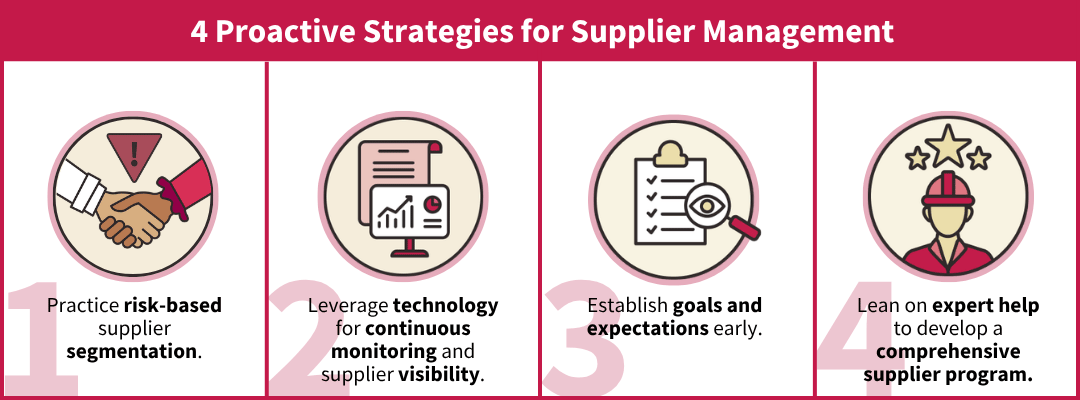
1. Implement risk-based segmentation
A key step in staying ahead of food safety risks is knowing which partnerships are most vulnerable — and which will have the most impact on your business if compromised. A risk-based supplier segmentation approach can help organize your partners into groups to prioritize prevention efforts.
You can assess and segment your suppliers into different categories based on common risk categories, such as:
-
Potential ingredient and product risks
-
Supplier performance and compliance history
-
Potential process risks
-
Potential hazard severity
-
Likelihood of risk occurrence
To determine the level of risk a supplier poses for your business across each of these categories, your team must evaluate the factors that can drive up potential risks, like:
-
Allergens present in products and processes
-
Pathogen exposure opportunities
-
Supplier audit results
-
Environmental exposure during production
Considering these factors will help identify which suppliers are at higher risk of food safety incidents (and therefore require more attention) and which are lower risk (and can be monitored less frequently). But even if your segmentation system categorizes a supplier as low risk, that doesn’t mean they are devoid of risk — and any risk a supplier can pose to your food safety operations should still be addressed proactively through preventive controls and supplier oversight techniques.
2. Leverage technology for continuous monitoring
Regular food supplier audits offer snapshots that can help establish a baseline understanding of your partners' compliance. But continuous monitoring can provide consistent, real-time insights that reveal potential vulnerabilities before they lead to food safety incidents.
Technologies like artificial intelligence (AI), blockchain, and Internet of Things (IoT) can help you create a food traceability and performance-monitoring program that enhances supplier visibility and streamlines data collection. These solutions offer access to real-time product data that will allow you to better monitor the integrity of your suppliers' products and make informed decisions about your supplier relationships.
3. Establish clear goals and expectations
Suppliers may not be aware they're creating risks for your business if they aren't on the same page about your goals and expectations. Food safety laws vary around the world, so making sure that you are upfront about which key performance indicators (KPIs) and benchmarks you prioritize is important to ensure your partnerships are aligned.
If you find that suppliers are still underperforming or failing to meet compliance standards, it’s important that your supplier program include a plan for providing clear, actionable feedback that your partners can leverage into tangible change.
4. Invest in expert-driven supplier program development
Sometimes you need external support to both identify where your food safety efforts could use the most improvement and implement changes to address those shortcomings. From systematic improvements to a total overhaul, third-party experts can be instrumental in optimizing your supplier program.
Partners in supplier program development can provide expert-led system design, program development, gap assessments, troubleshooting, and leadership support that will help your company build a mature, preventive food safety and quality system.
Transforming Your Supplier Approach With Expert Guidance
Shifting from reactive risk management to proactive risk prevention will help avoid food safety incidents (and their many consequences) within your supply chain — but it won’t happen overnight. The first step to making this pivot is determining where your program stands, both on paper and in practice.
Partnering with third-party experts can help you do just that. From highlighting gaps in your plan’s execution to suggesting updates that will drive risk prevention, specialists like those at AIB International can provide valuable insights to help you prevent supplier failures before they occur. Assign an expert to evaluate your supplier program today.