

If your team isn't bought into the "why" of food safety, they aren't truly understanding why their everyday responsibilities matter. Even if they complete their work as required, your team may not be conscious of how these tasks impact public health or your company's compliance. This lack of awareness can result in dangerous hazards going unchecked — from undeclared allergens to contaminated products.
To help your team see the bigger picture and understand the importance of their role in it, you need a well-defined core belief system that connects everyday food safety practices to a shared purpose. For businesses in the food and beverage industry, this belief system is known as your food safety culture.
But to develop a strong culture, your team needs to agree on a core set of expectations. AIB International's Consolidated Standards for Inspection can help define that blueprint.
Read on to learn why a food safety culture is pivotal for keeping the food supply safe, and how AIB International's Consolidated Standards for Inspection can help you strengthen that culture within your facilities.
Strong Food Safety Culture: An Essential for Prevention
Effective food safety goes beyond just teaching your team the ins and outs of good manufacturing practices (GMPs) and your standard operating procedures (SOPs). Truly successful food safety programs are centered around a cohesive food safety culture that encourages management and frontline employees alike to identify risks, take corrective action, and prioritize the safety of the product supply.
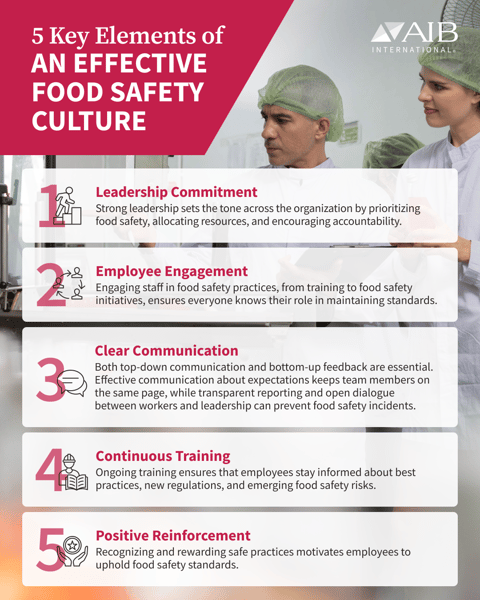
An effective food safety culture consists of a few key elements. The Global Food Safety Initiative's (GFSI) latest position paper on food safety culture outlines:
-
Company values, vision, and mission
-
Commitment, empowerment, and accountability among employees
-
Hazard and risk awareness
-
Food safety consistency
-
Adaptability, change, and continuous improvement
Aligning and nurturing these cultural pillars can help your team reach important business goals, including:
-
Supporting compliance and certification expectations: Food safety culture is increasingly becoming a standard for compliance across regulatory authorities, international standards bodies, and certification frameworks — and compliance is the first step toward truly effective food safety.
-
Driving a proactive approach to food safety: Teams with a strong food safety culture are more likely to identify procedural gaps before they become food safety risks or incidents.
-
Achieving successful food safety outcomes: Your food safety culture has a direct impact on how well your team performs food safety in the real world, because employees who believe in and understand the importance of what they're doing are more likely to execute food safety procedures with confidence and care.
Understanding the "what" and the "why" behind food safety culture is a good starting point. But the real challenge for many food manufacturers is figuring out the "how" of building a strong culture within their organization. This is where AIB International's Consolidated Standards become a vital asset.
How AIB International's Consolidated Standards Influence Culture
The AIB International Consolidated Standards have helped manufacturers outline the key requirements a facility must meet to produce food products safe for public consumption for 70 years. These standards include a set of best practices based on industry-wide Good Manufacturing Practices (GMPs) — offering clear guidance that translates complex regulatory language into practical terms your team can understand.
Businesses that use the Standards often also partner with Food Safety Professionals (FSPs) from AIB International to better understand how their current practices align with these expectations. FSPs can visit your facility to identify gaps, provide actionable insights, and generate a facility score based on observed findings. Your team can then leverage these findings to understand which improvements are needed to better align day-to-day processes with industry expectations.
But these standards are more than just a set of guidelines to help you pass inspection. They are a roadmap that you can use to educate your team on the importance of food safety, how expectations have changed over time, and how your team can do their part to facilitate proactive food safety — all essential elements of a strong food safety culture.
Educating team members on current industry expectations
A key element of a healthy food safety culture is a team that can adapt and improve continuously as the food industry evolves. But to stay up to date with modern expectations, practices, and thought leadership, your team needs the resources and education necessary to change.
AIB International periodically updates the Consolidated Standards to reflect changes in regulations, scientific knowledge, emerging technologies, and industry best practices; following them can help your employees stay connected to today’s industry and shape the behaviors, attitudes, and beliefs they need to prioritize food safety.
Increasing employee awareness of potential gaps
Empowering employees and increasing risk awareness are two core steps in developing food safety culture. Familiarizing your employees with Consolidated Standards involves your entire team in the food safety process, motivating them to identify where your operations might be falling short.
And because AIB International's Consolidated Standards are based on real-world regulatory expectations, teaching your team what's considered unsatisfactory allows them to better identify potential risks in your operations before they cause incidents or are discovered by an inspector. Armed with this knowledge, employees can take action to make corrections to minimize those risks.
Prioritizing open communication of identified issues
Even if they identify risks in your operations, several concerns might hold your employees back from sharing those deviations with management. Whether they fear retribution or don’t want to report their peers, employees might assume it’s better to keep small noncompliances to themselves rather than report them.
But following the Consolidated Standards and working with an FSP from AIB International can help your team understand that the opposite is actually true. These standards serve as a study guide for inspections. Neither the Standards themselves nor inspections conducted by FSPs are meant to criticize your facilities or your team; they are simply a tool to identify and correct lackluster or unsatisfactory food safety practices that could put your compliance and product supply at risk.
By using the Standards as a reference point and responding constructively when employees identify deviations, management can reinforce the understanding that identifying problems is a necessary and positive part of food safety — as long as those findings are reported, and not hidden.
Providing clear benchmarks for success
The quantitative scoring system included in the Consolidated Standards provides clear benchmarks for how well your facility performs against the expectations outlined in the Standards. When an AIB International FSP conducts a scored inspection under the Consolidated Standards, they provide a score across five categories totaling up to 1,000 points. These categories include:
-
Operational Methods and Personnel Practices
-
Maintenance for Food Safety
-
Cleaning Practices
-
Integrated Pest Management (IPM)
-
Adequacy of Prerequisite and Food Safety Programs
The FSP assigns a level of risk and score to each category, with scores of 135 or below deemed “Unsatisfactory” and the highest score of 200 assigned only when no issues or identified risk are observed. By evaluating risks across these five areas of facility performance, the Consolidated Standards allow your team to identify specific risks and opportunities for improvement.
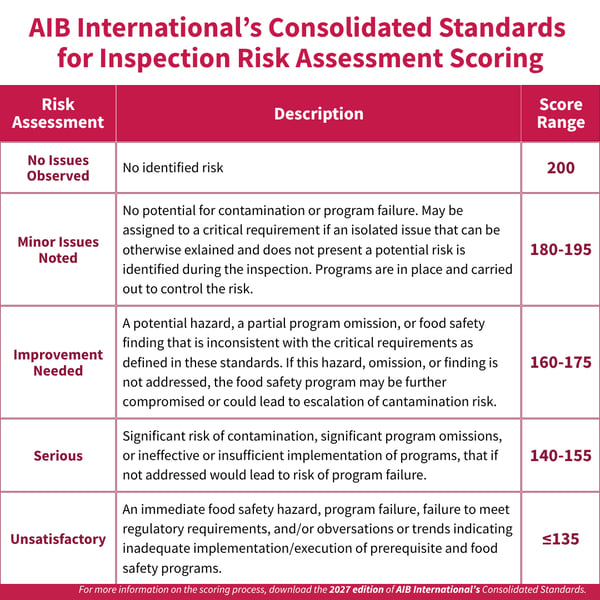
Transparency around your facility's scores also helps both frontline employees and management feel more confident during future inspections, as they will have a clearer picture of how effectively your team meets modern food safety expectations.
Build a Bulletproof Food Safety Culture
Establishing a food safety culture based on modern ideas, values, and practices helps your team take ownership of their work by showing they're part of something bigger than themselves.
But with so many standards to track and best practices to translate into day-to-day processes, AIB International's Consolidated Standards for Inspection, updated for 2027, provides a clear framework backed by support from real food safety experts.