

Intentional adulteration is a serious and growing threat in the food manufacturing industry. From 2009 to 2022, intentional adulteration during food manufacturing led to 205 deaths and 3,572 illnesses across 21 global events, while reported cases of food fraud worldwide jumped 10% in 2024.
Vigilance and preparation are key to defending your food products against potential contamination by bad actors — a requirement made clear by the FDA and EU General Food Law. That's what makes your food defense plan and its efficacy so vital to compliance.
Inspectors understand how instrumental an effective food defense plan can be in defending public health. They look for several key elements when reviewing your operations — but what are they, and how can you ensure you're in compliance? This guide offers expert insight to help you keep your food defense on guard.
Why a Food Defense Plan Matters
Under the FSMA Final Rule for Mitigation Strategies to Protect Food Against Intentional Adulteration, the FDA outlines the importance of preventing intentional adulteration that could damage public health. This rule is designed to “prevent acts intended to cause wide-scale harm” and applies to food facilities registered under the Federal Food, Drug, and Cosmetic (FD&C) Act. Similarly, EU General Food Law highlights the protection of consumers’ interests — including the prevention of food adulteration.
Your team is the first line of defense against these potential threats. But let's be honest — food defense is just one of many responsibilities on your team's mind, and when everything is a priority, nothing is.
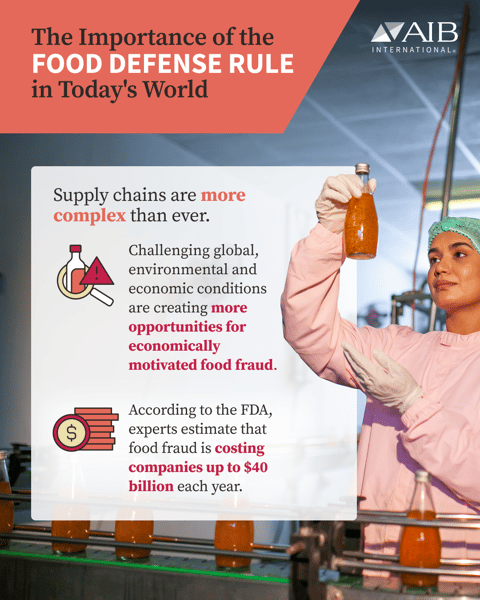
Between food safety and production demands, your team might be stretched too thin to detect intentional adulteration without proper guidance. That’s where your food defense plan comes in. When clear and effective, this plan serves as a roadmap for your team to identify and mitigate vulnerabilities.
Key Food Defense Plan Essentials to Satisfy Inspector Expectations
Your compliance with the FSMA Final Rule for Mitigation Strategies to Protect Food Against Intentional Adulteration hinges on your food defense plan's functionality. Inspectors determine your plan’s effectiveness and compliance based on its adherence to the core components outlined in this rule:
-
Vulnerability assessment: One of the most important keys to food defense is knowing where your operations may be exposed to intentional adulteration. Each step of your manufacturing process has vulnerabilities that bad actors can exploit to commit intentional adulteration and negatively impact public safety as a result. That's why the FDA requires you to run assessments on the potential severity, scale, and likelihood of adulteration at each phase of your operations.
-
Mitigation strategy: Once you’ve identified your vulnerabilities, you need a way to minimize or prevent the risks they present. Under the final rule, you must include strategies to protect against insider attacks for each actionable process step.
-
Monitoring, corrective action, and verification protocols: Once your strategy’s in place, you must develop steps to implement your mitigation plan. These actions can be unique to your organization’s operations and products, but must include monitoring procedures, corrective actions, and verification protocols.
-
Training and recordkeeping: Workers operating in vulnerable areas of your facility must train to understand the associated risks and responsibilities of their role. Additionally, documentation and recordkeeping of training, monitoring, corrective action, and verification efforts are essential to ensuring compliance.


Using these provisions, you can structure and implement a food defense plan that protects your products from intentional adulteration. But what comes next? After a plan is in place, you must maintain these standards to secure compliance.
How to Keep Your Food Defense Plan Inspection-Ready
Developing an effective food defense plan is a great starting point, but the work doesn’t end there. To ensure your plan is up to date when an inspection rolls around, you need to stay proactive.
Regularly review your plan
According to the FDA, your team must review your food defense plan at least every three years. However, you must also review current procedures in the event that certain criteria are met, including:
-
The discovery of improperly implemented mitigation strategies
-
When facility changes create the possibility of a new vulnerability
-
New information is released about potential vulnerabilities
-
When there is an uptick in real-world incidents
Conducting annual internal reviews can help keep your plan fresh. The more current your plan, the more in-tune it is with today's food defense environment. This keeps your team informed about potential threats to your operations, ensures your strategies are effective, and keeps your business compliant.
Test for effectiveness
As the saying goes: If you stay ready, you won't have to get ready. Even if the mitigation strategies you use were proven effective when you originally created your plan, you need to know that these practices still work to ensure your plan remains relevant. This is what makes testing so vital to preparedness.
Real-world, random test scenarios can determine whether your team is actually ready to defend against intentional adulteration — or whether your products remain vulnerable to attacks. According to the USDA, these tests should be performed at least annually and can be as simple as verifying the functionality of physical security measures, like locks and cameras. However, conducting more thorough testing provides a clearer picture of the overall quality of your mitigation efforts. these tests should be performed at least annually and can be as simple as verifying the functionality of physical security measures, like locks and cameras. However, conducting more thorough testing provides a clearer picture of the overall quality of your mitigation efforts.
To avoid potential bias, consider hiring a third-party expert to conduct a food defense evaluation audit and provide an honest assessment of your food defense plan before inspection time.
Use your resources
Nervous about your plan meeting FDA standards? Get your ideas straight from the source. The FDA provides resources for organizations building or improving their food defense plans. These include:
These tools can help build a food defense plan that is both unique to your facility and meets regulatory requirements.
If you're still feeling unsure about your plan's efficacy, get a second opinion. Leveraging the knowledge of outside experts can help you determine whether your food defense plan is audit-ready.
Invest in employee training
An effective food defense plan is nothing without a team that can implement it as intended. That's why food defense training is as essential as your plan itself. Your team should know how to:
-
Differentiate between food safety and food defense
-
Develop and implement a food defense plan
-
Mitigate the risk of intentional adulteration attacks
Empowering your team with the tools they need to succeed creates a workforce that plays a positive and active role in protecting your products from intentional adulteration.
Securing Your Food Defense Compliance With Expert Training
Intentional adulteration can come from anywhere. That's why inspectors are looking for a food defense plan that is not only well thought-out but also proven in its effectiveness, functionality, and relevance. Don't let your team be the reason why a functional strategy falls short of inspector expectations. Sign up for Food Defense Coordinator Online training with AIB International and transform your employees into your secret weapon against potential attacks.