
New to working with U.S. importers? Whether you’re hesitant to enter the U.S. market or you’ve landed your first partner and don’t know where to begin, you may have reservations about your role as an exporter under the FDA’s Foreign Supplier Verification Program (FSVP) rule.
But while working with U.S. importers might require that you adjust your current food safety practices to some extent, it doesn't have to mean starting over. Compliance with this FDA rule actually falls on U.S. importers; exporters’ role is largely to support this compliance. By maintaining food safety practices and controls that align with applicable FDA requirements, providing accurate, up-to-date documentation that demonstrates products entering the U.S. do not pose a risk to consumer health, and communicating transparently with their U.S. partners, foreign suppliers can do their part to meet U.S. expectations.
Discover what U.S. importers actually need from foreign suppliers under FSVP in this guide (so you can confidently participate in the substantial U.S. market for imported food and agricultural products).
FSVP Responsibilities: Common Myths Busted
To avoid confusion, frustration, or undue stress surrounding FSVP, it's important for your team to understand the reality of your role as an exporter in the FSVP puzzle. From liability to difficulty of adaptation, here are a few misconceptions you may run into during your journey.
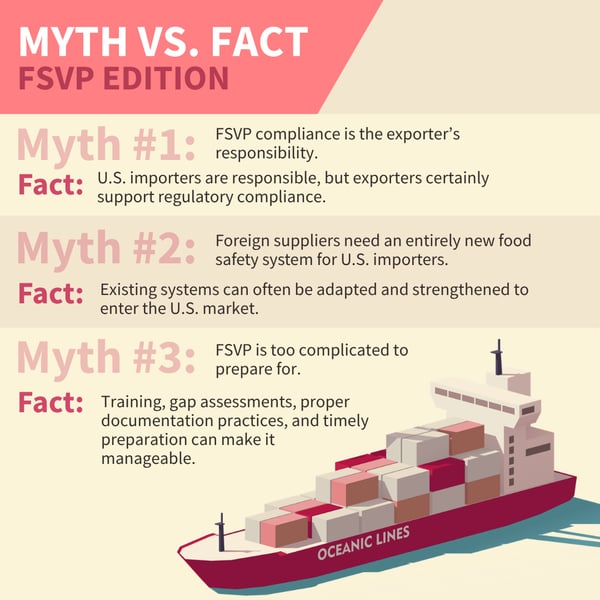
Myth: FSVP compliance is solely the responsibility of foreign suppliers
Between FSVP verification activities from import partners like on-site audits and testing, it can feel like your operations are under a regulatory microscope. In truth, much of the regulatory burden under FSVP falls on U.S. importers.
Reality: To remain compliant under the FDA’s FSVP rule, importers are responsible for developing, maintaining, and following a foreign supplier verification program for each applicable foreign supplier when importing food to the U.S. That said, your import partners still need your help to evaluate your food safety practices and controls to approve you as a supplier within their FSVP.
To partner with U.S. businesses, importers will likely request documentation from your business demonstrating that your food safety system aligns with the FDA requirements applicable to your products. If your food safety practices are not currently up to FDA standards, you may need to take corrective action to ensure they are before your partners can import your product.
Myth: Foreign suppliers need a separate food safety system for the U.S. market
Reality: Exporters may not need to maintain multiple food safety systems or start over on their food safety efforts. In many cases, your existing food safety system can be adapted to meet the preventive expectations of U.S. regulators.
At its core, FSVP is a system designed to protect consumers from harm — not create more hoops to jump through. By adapting your current food safety system, you not only provide peace of mind for your business partners, but for U.S. consumers as well.
Myth: Adapting to FSVP expectations is complicated and difficult
Reality: FSVP regulations may seem complex, but that doesn't mean it has to be hard for your team to align with the needs and expectations of your importers. By partnering with FSVP experts with U.S. regulatory experience, you can educate your team through exporter-specific training opportunities and identify potential procedural or documentation gaps through document reviews, gap assessments, or relevant on-site audits.
How Foreign Suppliers Can Support Their U.S. Partners to Meet FSVP Requirements
While FSVP compliance may not be your direct responsibility, your U.S. partners’ success is also your success. By analyzing, adjusting, and preparing your practices for importer review ahead of time, you can help importers complete supplier evaluations more efficiently — and encourage a smoother partnership as a result.
Take the initiative in your food safety strategy to assist your U.S. partners with these tips:
Familiarize your team with FSVP regulations
The best way for your team to align with FSVP as smoothly as possible is to familiarize them with what importers might expect before importers request documentation or begin verification activities. Investing in FSVP training can help get your team up to speed on FDA expectations for imported foods and foreign suppliers. With expert-led guidance, your team can learn the ins and outs of FSVP requirements and begin identifying necessary changes to meet potential import partner expectations.
Reviewing official FDA resources on the FSVP rule can also strengthen your team’s understanding and help their preparedness, while expert-led training can help them interpret the official language laid out in these resources.
Evaluate your internal processes to identify regulatory gaps and make corrections
Once you understand the information and documentation importers may request under FSVP, you can review your internal procedures and related documentation to evaluate whether your processes meet those expectations. You may discover that your current food safety system already meets FDA standards. However, you may also identify areas where you need to better align with U.S. regulations.
Proactivity in this process is key to streamlining business deals and maintaining positive ongoing relationships with your U.S. partners. Reactive suppliers might wait for importers to identify documentation gaps or request corrective action after performing verification activities — resulting in a drawn-out evaluation process or, in some cases, rejection. Addressing potential issues independently (prior to importer evaluation) can streamline the supplier verification process and strengthen your partnerships.
Conduct and share a hazard analysis
Your U.S. partners may not be well-versed in the commodity they’re importing from your operation. That means they must depend on your hazard analysis and rely on your product expertise when evaluating the risks presented by your product. In some cases, they may be able to rely solely on your hazard analysis without conducting their own — as long as they review and assess it and determine it meets applicable FDA requirements.
Regardless of whether they conduct their own, U.S. importers depend heavily on the accuracy and documentation of their foreign suppliers’ hazard analyses. When reviewing your analysis, your partners will need to understand:
-
Which hazards were identified
-
Which hazards require a preventive control
-
The preventive controls that are used, where applicable
-
The scientific justification behind each hazard and control decision
-
Whether the analysis aligns with FDA applicable requirements
Ensuring that your hazard analyses account for this information can streamline the supplier evaluation process and build good faith.
Verify the accuracy and effectiveness of your documentation process
Documentation is central to supporting FSVP compliance. Importers may rely on food safety history, on-site audit results, corrective action documentation, and other records to evaluate your performance as a supplier and ensure food safety alignment with FDA requirements. That's why the accuracy, completeness, and accessibility of your documentation process is essential to you and your partners' FSVP success.
Before your importers submit a documentation request, ask yourself:
-
Does my food safety plan align with applicable FDA requirements?
-
Can I quickly provide a current, accurate hazard analysis and supporting records upon request?
-
Is my verification evidence — such as testing results, environmental monitoring records, and audit reports — complete and accessible?
-
Are my corrective actions fully documented, from root cause analysis to closeout?
-
Are my records organized, accurate, complete, and easy to review?
-
Can my team explain the controls we use (or don’t use) and the reasoning behind those food safety decisions?
Making sure your records are complete, accurate, up to date, and readily accessible before your import partners request documentation will help avoid delays and prevent unnecessary strain on your business relationship.
Improving FSVP Readiness With Expert Support
Your U.S. import partners are responsible for complying with FSVP, but that doesn't mean you as an exporter don’t play a part in your mutual business success. Understanding how your food safety efforts impact your partners allows you to become a stronger partner and exceed expectations — without taking on any unnecessary burden.
To see if your business is ready to meet U.S. importer expectations under FSVP, consider bringing in a third-party expert. At AIB International, our food safety professionals have experience navigating U.S. food safety regulations, and you can leverage their expertise to stay ahead of importer requirements and better support your U.S. partners.